
Reasons to fall in love
What makes this place special.
- The migration reveals how rain, grass and animal movement connect the wider Serengeti-Mara ecosystem.
- Open plains, granite kopjes, wooded country and rivers create remarkably different wildlife settings.
- Resident predators, elephants, giraffes and birds make the Serengeti rewarding beyond the migrating herds.
- Patient observation turns a safari into an unfolding story of feeding, hunting, survival and renewal.
The first impression
A horizon that changes how you look
The Serengeti’s scale is not simply a matter of distance. It changes the relationship between an animal and its surroundings: a giraffe becomes a slender mark against the sky, a procession of wildebeest a dark seam across pale grass. Clouds cast moving shadows over country that seems to continue indefinitely. Before any dramatic encounter, the landscape offers something increasingly rare: room to watch without the scene resolving all at once.
Yet this is no empty plain. A patch of shade, a shallow drainage line or a scatter of granite rocks can concentrate life. Gazelles feed where the grass is short; vultures circle over a possibility still invisible from the ground. The more carefully you look, the less uniform the country becomes. Small changes in vegetation and terrain explain where animals rest, feed, hide and travel.
That combination of openness and detail helps explain why visiting the Serengeti can feel so absorbing. Wildlife is often visible within its wider setting rather than isolated from it. A lion lying in grass belongs to a scene that includes wind, prey and distant movement. The destination rewards both the broad view and the willingness to linger over one small part of it.

Rain, grass and movement
The migration follows a living map
The Serengeti Great Migration is best understood as a response to changing opportunities, not a procession following a timetable. Wildebeest, accompanied by zebras and gazelles, move through the wider Serengeti-Mara ecosystem as rainfall alters the availability of grass and water. Their routes cross the boundaries people draw on maps. The ecological story extends beyond Serengeti National Park into neighbouring landscapes and north towards Kenya’s Maasai Mara.
Rain does more than fill a drinking place. It brings new growth, changing both the quantity and quality of forage. Grazers respond differently to that resource: zebras can tackle coarser grass, while wildebeest favour shorter growth. Their feeding can complement one another, although movement remains complex rather than neatly choreographed. Herds spread out, gather, change direction and sometimes return to ground they have already crossed.
From a vehicle, this immense process becomes visible through ordinary actions. Animals lower their heads to feed, lift them to assess danger, then move a few paces or join a longer stream. Hooves disturb the soil; dung returns nutrients; hungry mouths reshape the grass. What looks like a single spectacular event is really countless decisions linking rainfall, vegetation and survival across an enormous landscape.
An experiential calendar
Seasons written in colour and sound
Seasonal change gives the Serengeti different moods rather than one definitive appearance. Following rain, fresh green growth can soften the plains and clouds build depth into the sky. As conditions dry, grasses turn gold and dust becomes part of the atmosphere. Neither version is merely a backdrop. Each changes how animals use the land and what a traveller might notice during an unhurried wildlife drive.
In the southern short-grass plains of the wider ecosystem, the early part of the year commonly brings concentrated calving when conditions are favourable. Young wildebeest must become mobile quickly, entering a world where keeping up matters almost immediately. Births attract predators, but the scene is also full of feeding mothers, resting calves and the constant contact calls of animals maintaining their connections within the herd.
Later movements often carry substantial herds westwards and northwards, with river encounters forming one possible chapter. These broad patterns help explain the migration, but rainfall can shift its timing and distribution. The most satisfying expectation is therefore not a particular spectacle on a particular date. It is the chance to encounter an ecosystem in one of its changing states, with something meaningful happening wherever attention settles.
The famous chapter, in context
Beyond the drama of a river crossing
River crossings have become the migration’s most recognisable image: tightly gathered animals, uncertain approaches, then sudden movement into water. In the northern ecosystem, the Mara River can present powerful currents, awkward banks and crocodiles. Yet a crossing is neither an appointment nor an inevitable performance. Herds may wait, graze nearby, approach and retreat, or move elsewhere without entering the river while visitors are watching.
The waiting itself reveals something important. A herd is made up of individuals responding to neighbours, terrain and perceived danger, not acting under a single command. One animal’s hesitation may hold others back; movement in one place can ripple through the group. Even away from water, a line of wildebeest choosing a route through uneven ground can make the tension between collective movement and individual survival visible.
Keeping crossings in perspective leaves room for other memorable scenes: zebras drinking cautiously, calves finding their mothers, or a herd gradually filling a valley. Responsible observation means giving wildlife space and never treating proximity as a reason to crowd or pressure animals. The value of an encounter lies in seeing behaviour unfold on its own terms, whether it lasts a few seconds or occupies a quiet hour.
Relationships in the grass
Predators make the plains more than a procession
A moving concentration of prey creates opportunity, but predators do not simply follow a banquet without difficulty. Hunting consumes energy and frequently fails. Lions must judge distance, cover and the condition of their quarry; hyenas combine hunting with scavenging and complex social behaviour. The Serengeti lets travellers see these relationships within a broad landscape, where a resting predator and a watchful antelope may occupy the same field of view.
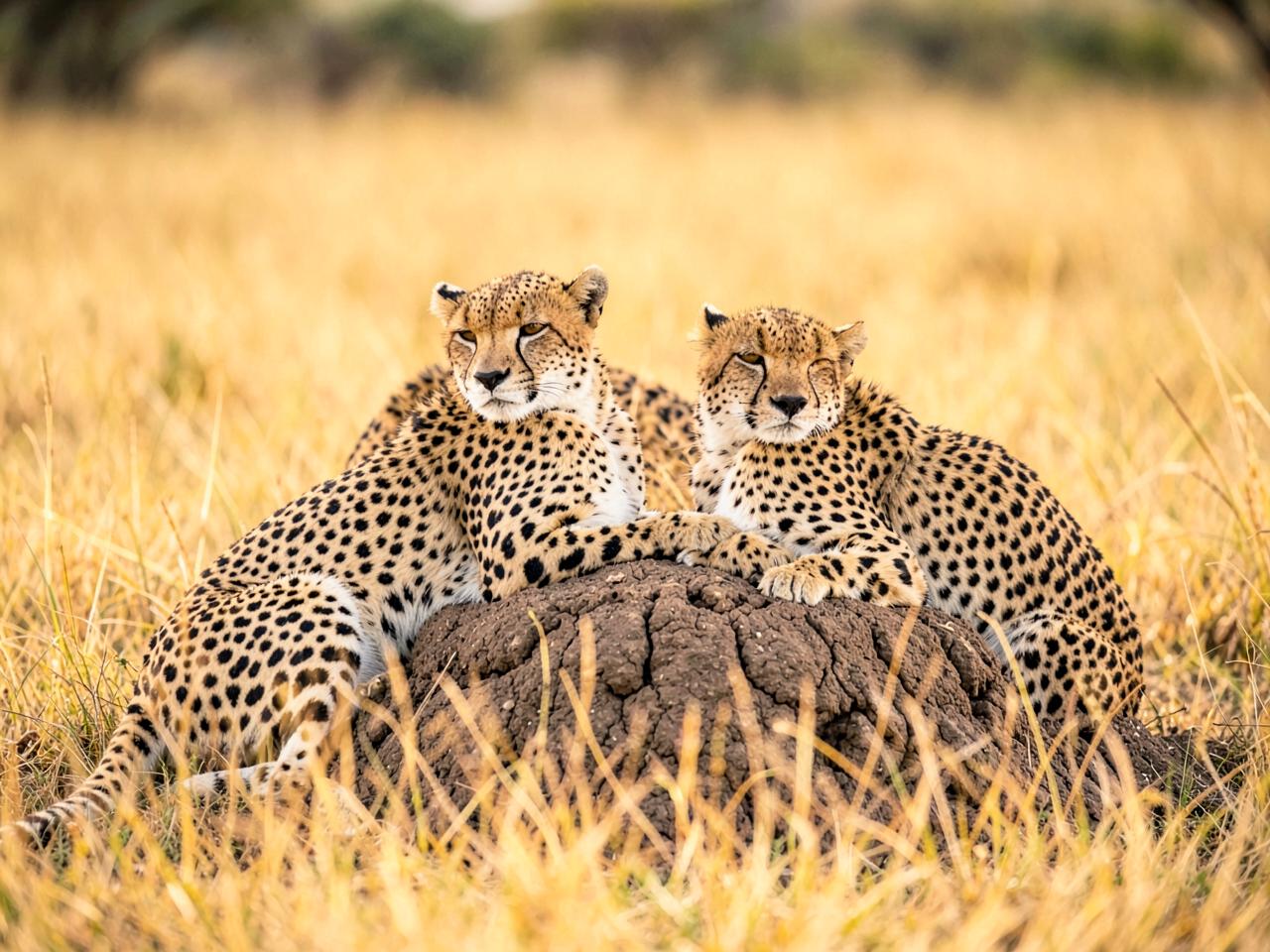
Cheetahs bring a different kind of suspense to open country. Their ability to accelerate is famous, but much of their day involves scanning, resting and choosing whether a pursuit is worth attempting. Watching one survey the grass can be as revealing as witnessing speed. Leopards, more elusive and closely associated with cover, offer another reminder that not all wildlife announces itself against the horizon.
Predator-prey relationships also extend well beyond the hunt. Vultures locate carrion from the air, other scavengers gather, and remains eventually return nutrients to the system. Even a seemingly still scene contains these connections. No particular sighting is assured, but understanding the possibilities adds depth: the plains become a network of appetites, risks and adaptations rather than a gallery of impressive animals.
Resident wildlife and ancient stone
The Serengeti that stays
When the largest migrating herds are elsewhere, the Serengeti does not become an abandoned stage. Resident wildlife continues feeding, breeding and defending territory. Giraffes browse woody vegetation, elephants move through suitable habitat, and hippos gather in available river pools. Their presence shifts the emphasis from mass movement to the particular character of a place: a stand of trees, a watercourse or a familiar patch of grazing.
Granite kopjes give that character a striking physical form. These rocky outcrops are remnants of ancient rock exposed through long processes of weathering and erosion. Rising above the grass, they create shade, crevices, lookout points and pockets of different vegetation. Lions may rest on them, while smaller animals exploit shelter among the stones. A kopje is both a landmark and a small collection of habitats.
Birdlife adds another layer that is easy to miss when attention rests entirely on mammals. Ostriches stride across open ground, secretary birds search for prey on foot, and raptors patrol overhead. Calls from wooded areas alter the soundscape along river corridors. Watching these less-publicised residents makes the ecosystem feel more complete and gives even a drive without large herds its own sequence of discoveries.
Attention as an experience
Learning to watch the whole scene
A wildlife drive can begin with the understandable desire to identify animals, then develop into something more satisfying: reading relationships. Why are gazelles looking in the same direction? Why has a grazing herd begun to bunch together? Sometimes the answer appears; sometimes it remains hidden. That uncertainty is part of the experience, inviting observation rather than reducing every moment to a completed list of sightings.
Light and weather help shape this attention. Low sun reveals contours that midday brightness can flatten; a breeze passes visibly through tall grass; approaching rain changes the colour of distant country. Pausing to take in those details makes the Serengeti memorable even between animal encounters. Photography can preserve a fragment, but looking beyond the frame often explains what makes that fragment significant.
The wider landscape is also connected to people, not sealed off from human history. Neighbouring communities have livelihoods and cultural ties to the region, while conservation involves ongoing decisions about land and wildlife. Respectful curiosity means avoiding romantic claims that this is a world untouched by people. Its extraordinary natural richness is better appreciated as part of a living region whose future depends on thoughtful stewardship.

An invitation to explore
Find your place in the living story
The Serengeti’s scale can stir a desire to see everything, yet its deepest pleasures often begin with one connection: fresh grass and a grazing herd, ancient stone and a resting predator. Friendslife Adventure is an appealing way to explore that fascination through a tailor-made wildlife experience, with room to discuss the particular parts of this living landscape that you want to understand.
A personal conversation can start with the migration without making it the only subject. Talk about the wildlife that absorbs you, the scenery you imagine and whether you prefer lingering over a scene or seeking a broader sense of the plains. Rain and animal movement do not follow a traveller’s script, so it is valuable to approach the Serengeti with interests rather than demands. Its resident animals, birds and rock outcrops deserve attention alongside the moving herds, whatever first drew you here.
Friendslife Adventure offers a warm starting point for that more open-minded journey. Its stated emphasis on authenticity and responsible travel resonates with experiencing the plains as a living place rather than a backdrop for one celebrated moment. Bring your anticipation, and let curiosity widen it. Explore the Serengeti further.
A little more to discover
Curious about visiting?
Does the Serengeti Great Migration follow the same schedule every year?
No. There are broad seasonal patterns, but rainfall, water and grazing influence where herds move and how long they remain. Think of the migration as a changing ecological cycle rather than a fixed annual timetable.
Is a river crossing guaranteed during a Serengeti visit?
No. Even when herds are near a river, they may wait, turn away or cross elsewhere. Grazing, social behaviour and movement across the plains offer rewarding migration encounters without a crossing.
Is the Serengeti worth visiting when the main herds are elsewhere?
Yes. Resident wildlife, including predators, giraffes, elephants and many birds, gives the landscape interest beyond the migration. Kopjes, woodland and river corridors support different encounters, although individual sightings always vary.
What makes watching wildlife in the Serengeti distinctive?
Its open landscapes often allow animals to be observed within a wider ecological scene. Travellers can watch grazing, vigilance and movement together, while changes in terrain, weather and vegetation help explain what the animals are doing.
More about the destination
Friendslife Adventure
Let the story become your experience.
Inspired to see it for yourself? Discover our journeys or talk to us about the places you would love to explore.