Reasons to fall in love
What makes this place special.
- Encounter mountain gorillas within a living forest, where feeding, resting and family relationships give each observation its character.
- Explore a steep landscape of layered vegetation, sheltered valleys and changing light rather than an open savanna.
- Discover Albertine Rift birdlife and a rich forest ecosystem that rewards attention beyond the headline wildlife.
- Understand how protected habitat, neighbouring communities and respectful visitors shape the future of this remarkable place.
Southwestern Uganda
A forest that sets the terms
Bwindi does not offer the instant panorama of an open plain. Its landscape arrives in layers: a ridge behind another ridge, mist caught along a fold of hillside, leaves that conceal far more than they reveal. In southwestern Uganda, Bwindi Impenetrable National Park protects a mountainous forest where the ground rises sharply and the canopy interrupts the sky. Before any gorilla appears, the place has already begun to change the way a visitor looks.
The word impenetrable suggests a solid green wall, but the reality is more intricate. Climbers thread through branches, ferns occupy damp ground and trunks create narrow windows into the understorey. A short stretch of walking can move from filtered light into deep shade. After rain, the forest may carry the scent of wet earth and decomposing leaves; when clouds lift, the contours of the surrounding hills become clearer.
This is the foundation of the Bwindi gorilla experience: wildlife encountered within a landscape that remains an active presence. The forest is not merely a backdrop for a photograph. It affects the pace of walking, the distance of a view and the sounds that reach you. Its rewards begin with accepting that a little patience, and a willingness to notice smaller things, belong to the journey.
An encounter approached on foot
Walking into the search
On a savanna, observation often begins from a vehicle, with room to scan across grassland. In Bwindi, the search is physical and close-grained. You move on foot through terrain that may include narrow paths, slippery ground and steep vegetation. Attention shifts from the distant horizon to the next foothold, a bend in the trail or a sound beyond the leaves. Neither approach replaces the other; they reveal wildlife at different scales.
Gorillas move through their habitat, so the effort involved in reaching them varies. Some walks are less demanding than others, but terrain and trek duration cannot be assumed in advance. A useful level of walking fitness, comfortable footwear with grip and readiness for rain help visitors engage with the forest rather than struggle against every change in footing. The return walk also deserves energy and attention.
Ranger direction is central to the experience, both during the search and when a group is located. Uganda Wildlife Authority permits and ranger rules apply; confirm the current requirements and access arrangements with UWA before visiting, then follow the briefing given on the day. Within that structure, the approach becomes part of the encounter’s meaning: an animal found in its own habitat, rather than summoned into a visitor’s view.

Mountain gorillas
The quiet complexity of a gorilla family
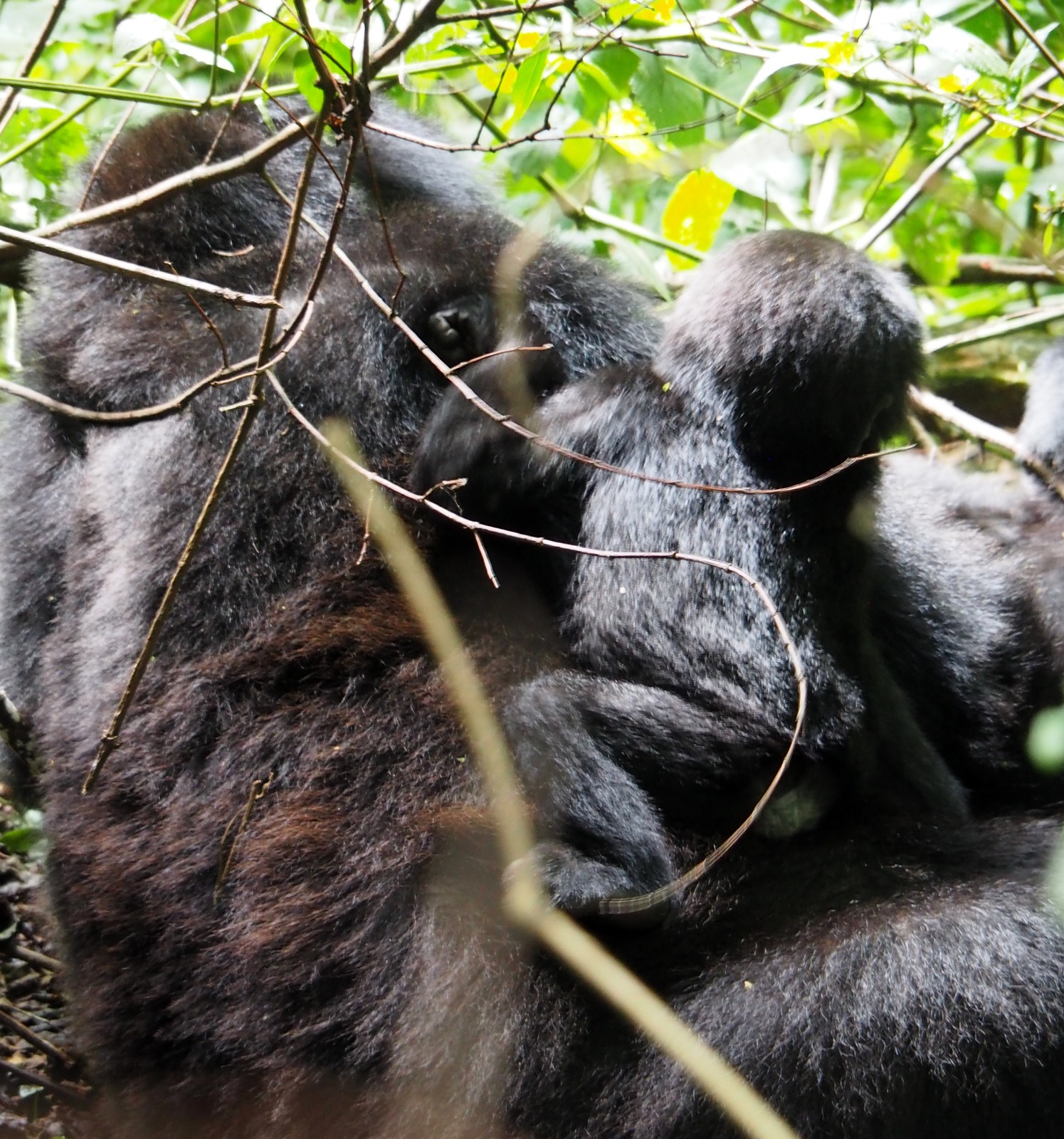
The first impression of a mountain gorilla may be its size, but sustained attention often settles on something quieter: a hand gathering vegetation, the rhythm of chewing, an individual choosing a comfortable place to rest. Mountain gorillas feed largely on plant material, and much of their day involves feeding and resting. An encounter need not be dramatic to be absorbing. Ordinary behaviour is precisely what makes it a glimpse of another life.
A group can include a dominant silverback, adult females and younger animals of different ages, although family composition varies. The silverback’s presence is important to the group’s cohesion and protection, but the interest extends beyond a single imposing figure. Younger gorillas may play; adults may sit close together or attend to their own feeding. What is visible depends on the family, the vegetation and the moment, not on a promised performance.
Habituated gorillas remain wild animals. Habituation allows particular groups to tolerate carefully managed human observation; it does not make them tame or turn proximity into an invitation to interact. Keep your behaviour calm and follow ranger instructions about positioning, movement and photography. If a gorilla looks towards visitors, its meaning should not be embellished into an imagined bond. The encounter is powerful enough without assigning it a human script.
Natural history
An old forest with many layers
Bwindi’s importance reaches beyond its most famous residents. The forest lies within the wider Albertine Rift region, a landscape known for exceptional biodiversity and species with restricted ranges. Its varied elevations and folded terrain create differences in moisture, exposure and vegetation. A sheltered valley and a higher slope need not offer the same conditions, helping explain why so much life can occupy a seemingly continuous expanse of green.
Trees provide structure, but the ecosystem is built through relationships. Fruit feeds animals that can disperse seeds; insects visit flowers or break down fallen material; fungi and other decomposers return nutrients to the soil. Leaves accumulating beneath the canopy are not simply untidiness. They belong to the processes that sustain the next generation of growth. The forest’s richness is as much about these connections as about a list of species.
Bwindi’s UNESCO World Heritage status recognises its conservation significance, including its biodiversity and mountain gorilla habitat. For a traveller, that importance becomes tangible in details: vegetation occupying several heights at once, water running through a shaded hollow, a decaying trunk supporting new life. Seeing the forest this way adds depth to the gorilla encounter. The animals depend on an entire functioning habitat, not just the patch of foliage surrounding them.
Birds and forest wildlife
Learning to listen beyond the gorillas
A forest can be full of birds without offering easy views of them. Calls carry through the canopy while their makers remain behind leaves, and movement may register first as a flicker between branches. Bwindi forest wildlife rewards a different kind of attention from scanning open country. Listening, pausing and looking into one small area can be more productive than continually searching for a larger scene.
For bird enthusiasts, the attraction includes Albertine Rift specialities such as the handsome francolin and Rwenzori batis. African green broadbills are another much-sought forest species, though finding any particular bird depends on habitat, conditions and patient searching. Even visitors without a bird list can enjoy the changes in sound and colour that interrupt a walk. A clear view of one unfamiliar bird may become a memorable discovery in its own right.
Other forest residents are often elusive, and dense vegetation limits what can be seen. That uncertainty is worth embracing rather than treating as a deficiency. The absence of a visible animal does not mean an empty forest: a rustle, feeding remains or a distant call may suggest activity beyond sight. Making room for birdwatching and quieter observation broadens the visit, so that its value does not rest entirely on one anticipated encounter.
The landscape between sightings
Mist, water and the pleasure of slowing down
Bwindi’s atmosphere comes partly from the way weather changes its appearance. Mist can soften a ridge into an indistinct outline, while a break in cloud brings definition back to leaves and distant slopes. Rain is part of the forest’s character, not an interruption imported from elsewhere. Conditions vary through the year and within a day, so no season can promise a dry walk or a particular quality of light.
Streams gather water from the hills and run through shaded ground, linking the forest’s steep upper slopes with its valleys. Where authorised walking routes are available, exploring beyond gorilla tracking can reveal these quieter aspects of the park. Route availability and accompanying ranger requirements should be checked locally with UWA. There is no need to make every outing an ambitious search; simply attending to canopy, water and undergrowth can be rewarding.
The landscape also changes the rhythm of observation. On steep ground, pauses allow breathing to settle, but they also create opportunities to notice how roots grip a bank or how light reaches a fern. Photography may capture a fragment of this texture, yet the experience includes things a frame cannot hold: humidity, uneven footing and sounds whose sources remain hidden. Bwindi invites a kind of travel in which sensory detail matters as much as a landmark.
Conservation and neighbouring communities
A protected forest beside lived-in hills
Bwindi is not isolated from human life. Beyond the protected forest are cultivated hills, settlements and people whose livelihoods and histories are connected to this landscape. The boundary brings different needs into close proximity: safeguarding habitat, growing food and sustaining local opportunities. Understanding that context prevents the park from becoming an imagined wilderness with nobody beyond its trees.
The Batwa have longstanding ancestral connections to forests in this region, and conservation history includes their displacement from protected forest land. Their story should not be reduced to a picturesque addition to a wildlife visit. Where community-led cultural experiences are offered, a respectful approach makes room for the hosts’ own accounts, contemporary lives and choices about what they share. People are participants in the region’s present, not exhibits from its past.
Gorilla conservation likewise depends on more than the actions of visitors, although considerate tourism has a role. Protected habitat, monitoring and the involvement of neighbouring communities all matter. During an encounter, following ranger guidance and avoiding contact with wildlife are practical ways to respect the system that makes observation possible. The lasting reason to care for Bwindi is broader still: a living forest supports many species and remains intimately connected to the country around it.
Explore with Friendslife Adventure
Enter the forest with more than anticipation
Bwindi asks something different of a traveller: patience with an enclosed landscape, attention to sound and a willingness to let the forest shape the experience. Friendslife Adventure is a thoughtful starting point for readers drawn to that kind of encounter. Its tailor-made approach makes space for a personal conversation about the gorillas that inspire your visit and the living forest that gives their presence meaning.
Talk about what you find compelling in gorilla family behaviour, but also about birds, tangled vegetation and the landscape beyond the canopy. Sharing your preferred pace and any concerns about moving through steep terrain can help make the discussion more personal and realistic. The attraction is not a promise that every imagined moment will happen. It is the opportunity to approach Bwindi with clearer interests, realistic expectations and a readiness to notice what lies between the moments of greatest anticipation.
Friendslife Adventure’s stated emphasis on responsible travel and authenticity fits the spirit of entering a protected forest attentively. For a reader who wants more than a wildlife photograph, that is a meaningful reason to explore its approach. Let the canopy, the calls and the quiet family behaviours draw you further.

A little more to discover
Curious about visiting?
What makes a Bwindi gorilla experience different from a savanna safari?
Bwindi is explored on foot through mountainous forest, where vegetation limits views and the search becomes part of the experience. Instead of scanning open grassland from a vehicle, visitors observe gorillas at the forest’s smaller, more intimate scale, under ranger direction.
How physically demanding is gorilla tracking in Bwindi?
The terrain and time spent walking vary with the gorillas’ location and the route. Steep slopes, rain and slippery footing can make it demanding. Walking fitness and footwear with good grip are helpful; discuss your mobility needs beforehand and follow the ranger briefing.
Is Bwindi worth visiting for wildlife beyond mountain gorillas?
Yes. Its forest habitats support rich birdlife, including Albertine Rift specialities, alongside other often-elusive wildlife. Birdwatching and authorised forest walks reveal the canopy, streams and ecological relationships that make the park significant beyond its gorillas.
How should visitors behave during a gorilla encounter?
Remain calm, avoid touching or attempting to interact with gorillas, and follow ranger instructions about movement, positioning and photography. Uganda Wildlife Authority permits and rules apply. Confirm current requirements with UWA before visiting rather than relying on old advice.
More about the destination
Friendslife Adventure
Let the story become your experience.
Inspired to see it for yourself? Discover our journeys or talk to us about the places you would love to explore.